
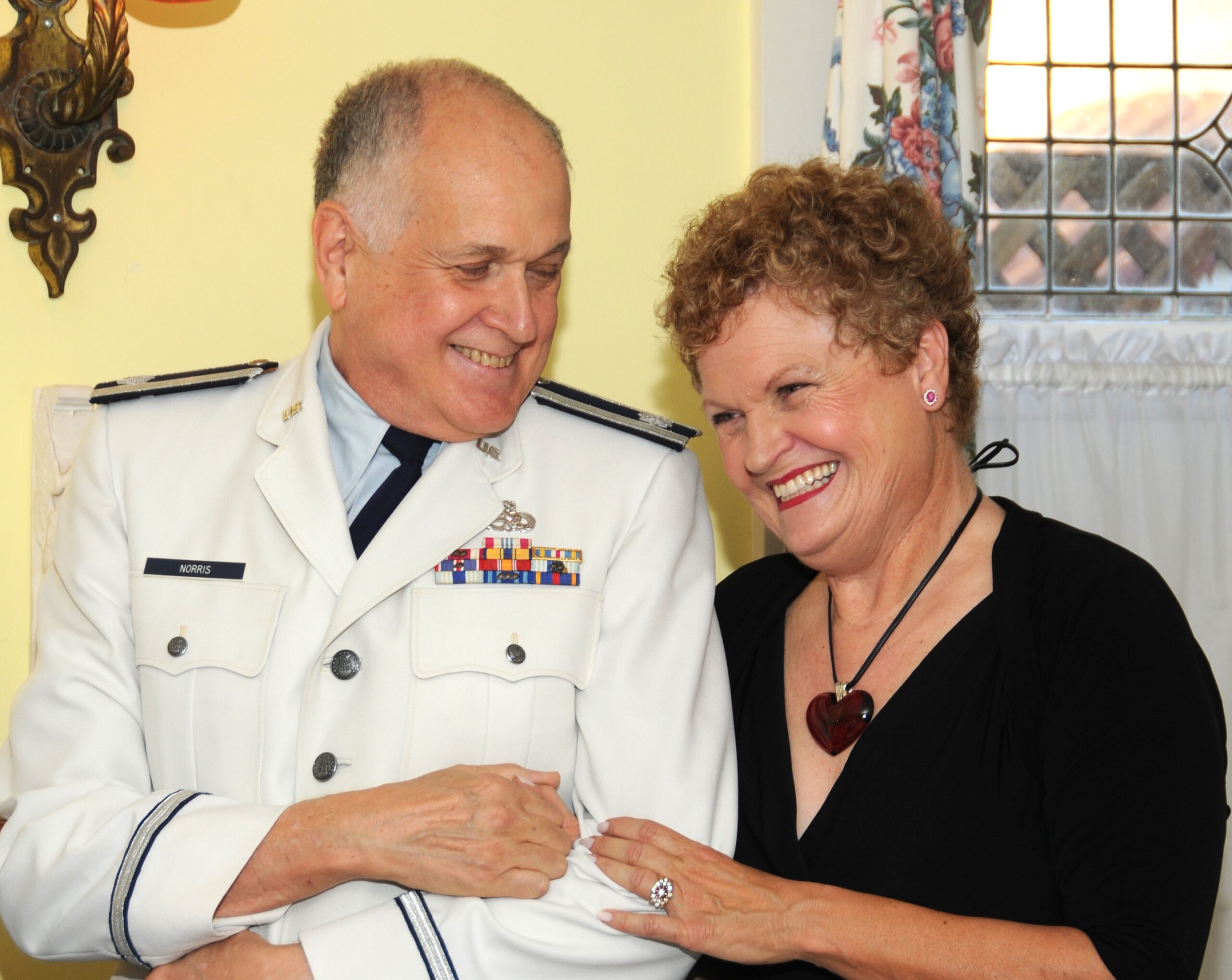
Tom and his wife, Marianne, at their 25th anniversary vow renewal in 2013.
Our Voices Matter: Don’t Conduct Research ‘About Us Without Us’
By Jill Waldbieser
Joseph T. Norris, Jr., Lt. Col., USAF (Retired), MPA, BCPA—who goes by Tom—was 35 when he was diagnosed with testicular cancer. He eventually achieved remission, thanks to surgery and radiation treatment, but was left with a lifelong shadow: persistent pain.
The radiation left behind scar tissue in his lower abdomen that affected the vertebrae and surrounding tissue in his spine. He began having flare-ups that he says felt like “someone placed a flaming spear through me.”
Though pain is a well-known side effect of radiation therapy today, “at the time,” Tom says, “the military didn’t seem to recognize that chronic pain existed.” After an incorrect initial diagnosis of a brain tumor and several treatments, including back surgery, that failed to help, the Air Force deemed Tom’s pain “intractable.”
He was medically discharged after 23 years of active service; the medical evaluation board making the call told him, “You’ll never be able to do anything.”
“For me,” he says, “that was worse than the pain.”
But Tom, who lives in Los Angeles, has done plenty. He has spent the last 37 years supporting others learning to live with chronic pain, working to improve the design of clinical trials that advance pain management, and fighting to ensure the patient voice is centered in pain research.
“Chronic pain forced me to give up a career I loved, reimagine my purpose, and find new ways to keep going,” says Tom, now 76. “But it also made me an advocate, gave me a way to help others, and taught me how strong we really are when life doesn’t give us a choice.”
FROM TREATMENTS TO TRIALS
Tom’s wife, Marianne, has been a huge source of support and courage from the beginning, standing with him through years of challenges.
“After the military retired me, we hit the ground running trying to find somebody who could help me take care of the pain,” he says. “I’ve thrown just about everything at this pain over the years.”
The list included medications, physical therapy, massage, aquatherapy, yoga, Tai Chi, cognitive behavioral therapy (CBT), acceptance and commitment therapy (ACT), TENS units, acupuncture, biofeedback—and even a device created by a friend, originally for horses with leg pain, that alternately applied hot and cold air with the goal of sending endorphins to the affected area to reduce pain.
The quest for pain relief expanded further still: He tried magnets, electrotherapy, positive imaging, writing, attention diversion, relaxation techniques, hands-on healing, remote healing, computer-aided diagnosis, honey and royal jelly (a nutrient-rich bee secretion), and surgery to try to relieve his groin pain by freezing the ilioinguinal nerve—performed without anesthesia, with Tom strapped to the table, so that he could help the surgeon identify the correct nerve.
“Some things helped a little, some not at all, and a few just reminded me how stubborn pain can be,” Tom shares.
The burning, stabbing, and scraping sensations are constant—spanning his back, hips, legs, abdomen, and groin. On any given day, his pain level hovers around an eight out of 10. “It feels like battling a dragon with huge, flaming talons,” Tom says. “Sometimes I can push it off, but most of the time, the dragon wins.”
He eventually realized he might never be rid of the pain. Instead, he would have to find ways to manage it.
In an effort to find something to occupy his mind besides endless doctor’s visits, he taught crowds of at-risk local children in his driveway for several years—reading, cooking, art, computers, volunteering, and more.
He was also active in his church, and has been a patient advocate for the American Chronic Pain Association (ACPA) for nearly four decades.
Then about 10 years ago, ACPA founder Penney Cowan encouraged him to get involved with a clinical trial funded by the Patient-Centered Outcomes Research Institute (PCORI). There, serving as a patient adviser, he found himself a member of the research team.
That changed everything.
A SEAT AT THE TABLE
Tom is a problem-solver. And he saw a lot of problems with how chronic pain was studied and treated—and how the results of a clinical trial are communicated to the people actually affected by the research.
“They’re doing stuff about us without us,” he says. “Once I stepped into that first research role, I saw how decisions were made, how studies were shaped, and just how much was missing when people like us—people with lived experience—weren’t in the room.”
In his first patient advisory role, he helped develop surveys and recruitment materials, analyzed results, ensured information was patient-friendly and patient-centered, and wrote the study’s patient engagement report. The team listened. And the study benefited.
He continued to sign up for every trial he could, six so far—most often as a patient adviser—and has been asked to participate as a patient adviser in six more. Study topics have ranged from treatments for chronic low back pain and gastrointestinal cancer-related abdominal pain, to the inclusion of underserved and underrepresented communities in research and delivering virtual reality treatments to rural patients.
Being a patient adviser has shifted Tom’s perspective on his own pain. “I’m not just surviving it,” he says. “I’m using it to help change how pain is understood and treated.”
Tom serves as a PCORI merit reviewer and ambassador, as well as a consumer reviewer for the Congressionally Directed Medical Research Programs (CDMRP). He is listed as an author on several research papers from studies he supported as a patient adviser. He has also participated in guideline development panels, which bring together diverse perspectives to offer recommendations for clinical practice.
“Somewhere along the way, I realized how this all connects: Clinical trial results feed into guidelines, guidelines shape what insurance will cover, and both influence laws,” he explains. “That’s advocacy.”
‘EQUAL MEMBERS OF THE TEAM’
Today, Tom is making the kind of impact he’d feared would come to an end along with his Air Force career. In addition to his tireless efforts to ensure individuals with lived experience are included in every aspect of the pain research process, he is a volunteer and advocate with the U.S. Pain Foundation and the American Chronic Pain Association. He leads or sponsors multiple peer support groups.
He works with organizations such as the United States Association for the Study of Pain to improve the dissemination and deployment of clinical trial results—in some cases, the time between research and active implementation in medical practice can span close to two decades.
Tom has also been diagnosed with diabetes, painful neuropathy, high blood pressure, and PTSD. He’s lived through the diagnosis and treatment of skin and bladder cancer, and several heart attacks.
“With all my comorbidities,” he says, “I have a shelf life.” He hopes to find others who can carry on his work. Their voices matter. Researchers continue to recognize that including people like Tom on the team makes research efforts more accurate and meaningful—truly reflecting the lives they’re working to improve, he says. And that’s why he keeps showing up. His hope is that patient-engagement efforts in pain research will eventually become the standard for clinical research of all types.
Tom credits his faith, Marianne’s unwavering love and support, a CBT-based virtual reality program for managing back pain, and the occasional epidural for helping him, as he puts it, “manage the unmanageable.” He has learned that “living with pain doesn’t mean giving up—it means finding new ways forward.”
Ensuring the patient voice is centered in research, and that people with lived experience are treated not as “add-ons” but as integral members of the team, is one of his ways forward.
“It’s a chance to make a difference—not just in your own life, but in the lives of others living with chronic pain,” he says. “At the heart of it, this is about something bigger: Making sure people like us aren’t just invited to the table; we help set it. Our voice can improve health care for all.”