
By Alina Savulescu
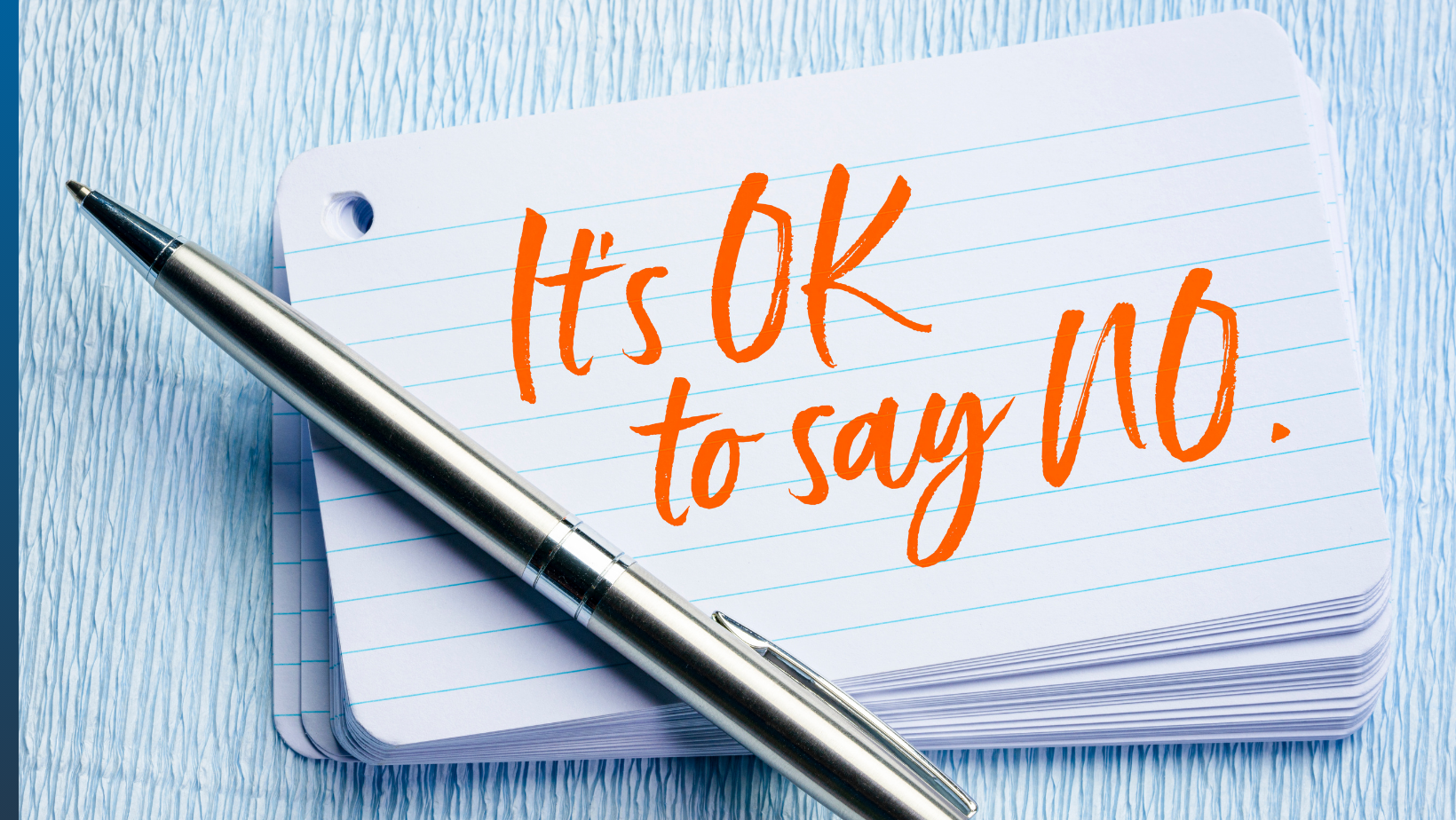
“No” is still the word I struggle with the most.
Even now, after learning what ignoring my limits costs me, I still feel the discomfort rise when I say that word out loud. I still catch myself over-explaining, softening the refusal, or trying to prove I am not exaggerating. Saying no can bring relief, but it often also leaves behind a small storm of guilt.
I recently listened to an episode of “The Moth” podcast where a storyteller reflected on the end of his 30-year marriage. He described looking back at family photos of weddings, graduations, and beach days. All joyful, beautiful moments. Then he said something that stopped me cold: he wished he had photos of the other moments. The fights, the hurting, the quiet trampling of each other’s needs.
That struck a deep chord with me, because it is exactly what happens when you live with chronic pain. People see us laughing, traveling, or going out for dinner. They do not see the medication we took before walking through the door, or the anxiety running in the background while we sit and sip coffee. They don’t feel the ache rising when a friend says, “Let’s grab one more drink.”
For a long time, I was trapped in a quiet expectation that the people around me would notice when I was reaching my limit. I thought that if they cared and knew I was in pain, they would naturally say, “Go home, rest.” But most of the time, that didn’t happen. And truthfully, no one should have to guess. No one but me can truly feel the effort it takes for me to stay present.
Behind that silence was an exhausting internal confusion. Because chronic pain is entirely unpredictable, what is manageable today might be completely impossible tomorrow. So every choice carries its own doubt:
Can I really not do a bit more?
What if they’ll think that I’m able to, but I just don’t want to?
Maybe I should just push through.
That friction turns a physical limit into a moral dilemma, until I find myself trying to prove my pain, even to myself.
So I kept saying yes while my body screamed no. I became like an image I saw years ago, of a horse whose rope is tied to a flimsy plastic chair. It could have snatched that chair and run free at any second, but it stayed, bound by the belief that it was trapped. Every “yes” I gave that went against my own needs became another invisible rope, tying me unnecessarily to situations that made my symptoms worse.
Starting With a Clearer No
Learning to set boundaries has shown me that saying no does not have to mean pushing people away. In many ways, boundaries are what keep a relationship honest, allowing me to name my limit before my symptoms make it obvious.
Most of the time, that honesty does not need a grand speech. It can be as simple as telling a friend, “I can’t manage dinner tonight, but I’d love to see you for a short coffee next week,” or saying at a gathering, “I may need to leave early if my symptoms flare.”
These are not excuses. They are small bridges built on sincerity, ways of keeping a relationship intact without pretending my body can do more than it’s able.
Rewriting these deep habits feels overwhelming. There is no straight, clean, heroic way through it. Sometimes, my “no” came late, when I had already gone past my limit. What actually helped were the smaller times I practiced saying no: small favors I did not take on, and plans I changed before they became too much. Those little refusals helped me build the confidence I needed for harder choices later on.
Still, no matter how much you practice, the moment after setting a boundary can feel intensely awkward. You might face a disappointed look or a sudden shift in tone, and the temptation to rush in and fix the silence is real. Resist that urge.
After a difficult “no,” I have often felt a new kind of pressure: the need to prove that I really needed the time I protected, as if my rest had to look productive or serious enough to count. But that space does not have to become a performance. It can be as ordinary as staring at the ceiling, reading a few pages, or stepping outside for a short walk. I do not have to keep busy resting to make the boundary real. I only have to let myself have the room I asked for.
Making Room for a Stronger Yes
A therapist once told me that when you start saying “no” to people who are used to hearing “yes,” it feels like pulling a pin out of a mechanical toy. At first, everything wobbles. The toy moves awkwardly, looking like it might lose balance or break entirely. Relationships often do the same when we change the rules. People might wonder why you used to agree to everything, and now you hesitate. But with time, the mechanism learns to function in a new way. It settles into a rhythm that is different, but far healthier.
A moment of discomfort is always better than long-term resentment. When we say yes purely out of guilt, we might buy a few minutes of peace, but the internal cost is high. It shows up later as profound exhaustion, flaring symptoms, and a quiet bitterness toward the people we were trying not to disappoint—and toward ourselves for ignoring our own boundaries.
When you say no instead, the sense of having let someone down may still come up; mine certainly does. In those moments, I read the notes my body sends through sensation: pain, fatigue, or the simple relief of having stopped in time. That helps me stand by my choice. It gives me back the feeling of being myself, because nothing settles me more than the moment my mind and body stop pulling in opposite directions. Most of the time, guilt is only the echo of an old habit, the last breath of a familiar torment.
Every time I have challenged the reality of my physical limits by pushing through, I have lost. Chronic pain already demands a great deal of energy, and preserving what little I have left has given me the chance to really enjoy the moments I choose and to do the work I need to do. It’s given me the chance to show up for the people I love and be a participant in my life, not a spectator.
Saying an honest “no” helps loosen the grip on that flimsy plastic chair. It allows the relationship to wobble for a moment, while it learns to stand on something more solid and real.
Subscribe to our newsletter

U.S. Pain Foundation is a 501 (c)(3) nonprofit organization dedicated to serving those who live with conditions that cause chronic pain, as well as their caregivers and care providers. Learn more.
Our Sponsors
U.S. Pain Foundation relies on the generosity of donations and grants. We are especially thankful to our Corporate Council for sustaining our programs and services year-round. Learn more.
Contact Us
U.S. Pain Foundation, Inc.
15 North Main Street, Unit 100
West Hartford, CT 06107
Telephone: 800.910.2462
Email:
contact@uspainfoundation.org
Tax ID number: 26-2703521
All Content Copyright 2021 | All rights reserved. U.S. Pain Foundation is a qualified 501(c)(3) tax-exempt organization. Disclaimer