
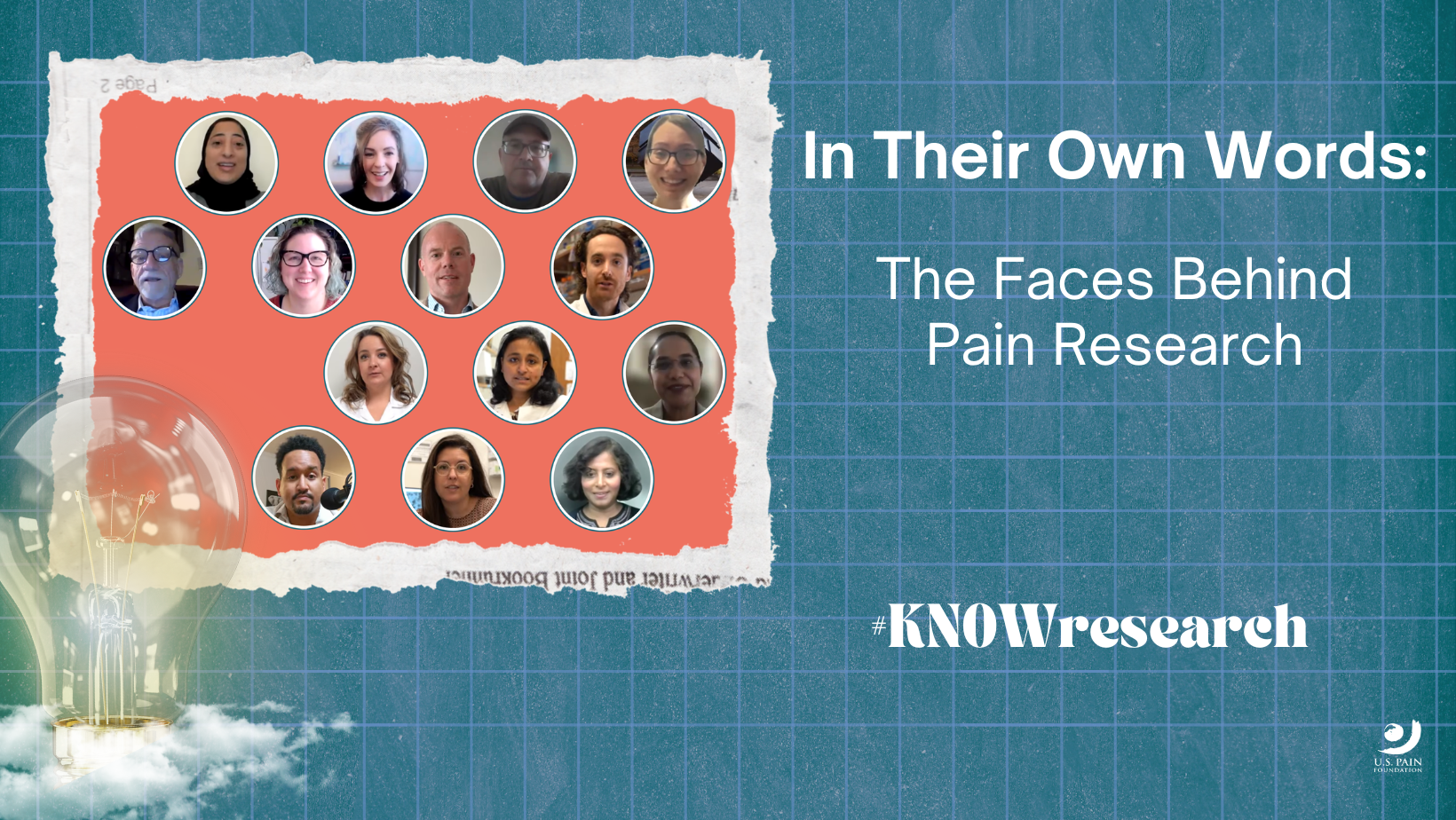
Throughout the U.S. Pain Foundation’s #KNOWresearch campaign this KNOWvember, pain scientists across the country shared personal videos about the research they’re conducting—and why pain research is so important.
This effort, which was made a reality thanks to a collaboration with the United States Association for the Study of Pain (USASP), puts a face to pain research and seeks to make pain science more accessible to those it’s meant to serve.
Here, learn more about the diverse landscape and multifaceted nature of pain research, and what the scientists conducting it hope to accomplish—in their own words.
Sarah Alzahid, PhDc
Role: PhD candidate in nursing science at the University of Florida College of Nursing; former emergency nurse
Research: Using electronic health record data to identify individuals living with post-stroke pain, identify effective treatments that best impact recovery and quality of life for stroke survivors, and improve patient-provider communication.
Impact: “My goal is to uncover the clinical patterns that can help providers recognize post-stroke pain earlier, assess pain more precisely, and tailor treatments to each patient’s needs. By bridging nursing research, data science, and clinical care, I am contributing to more effective and compassionate approaches that enhance comfort, function and the overall well-being of stroke survivors.”
Watch the full video here.
Meaghan Creed, PhD
Role: Associate professor at the Washington University School of Medicine Departments of Anesthesiology, Neuroscience, and Psychiatry; investigator at the Washington University Pain Center
Research: How the neurons in the brain that produce dopamine—the chemical associated with motivation—misfire and fail to maintain their activity in individuals living with chronic pain, making treatment success more difficult.
Impact: “If we can understand why and how these neurons are failing, we could develop strategies that will allow us to rescue these changes or to compensate for these brain changes to help people with chronic pain regain motivation and will and drive again—not by numbing the pain itself, but restoring the brain’s motivation to live and think clearly.”
Watch the full video here.
Steve George, PT, PhD, FAPTA
Role: Professor of orthopaedic surgery at Duke University School of Medicine; Duke Clinical Research Institute member; editor-in-chief of the Physical Therapy and Rehabilitation Journal; licensed physical therapist
Research: Examining individual factors that may impact who develops pain after total shoulder arthroplasty, as well as exploring non-drug care pathways offered to individuals with low back pain.
Impact: “Physical therapists see a lot of people with pain, especially musculoskeletal pain, and I was really struck by how little we knew about pain and how, frankly, ineffective some of our approaches that we learned as physical therapists were for people with pain. As I moved from a practice to a research career, the main motivation was my inability to answer relatively simple and straightforward questions for people with pain. I’m hoping to help others provide better answers.”
Watch the full video here.
Mary Janevic, PhD, MPH
Role: Research associate professor of health behavior and health equity at the University of Michigan School of Public Health
Research: Developing and testing educational programs to support older adults in learning how to better manage chronic pain, utilizing community health workers who share life experiences with participants and connect them to resources.
Impact: “Our research projects are focused on underserved communities, where people may lack access to the resources that they need that can help them better manage their pain—like transportation to get to a Tai Chi class at the senior center. We hope that with our research, we can show that these types of low-cost programs are effective at helping older adults with chronic pain feel and function better.”
Watch the full video here.
Bob Kerns, PhD
Role: Senior research scientist and professor emeritus of psychiatry at Yale University School of Medicine
Research: Co-leading several efforts funded by the National Institutes of Health and Veterans Affairs to increase collaboration between research investigators and individuals with lived experience of pain, to better promote the incorporation of patient voices in research design.
Impact: “I now consider myself a passionate advocate for explicit, directed efforts to engage patients and people with lived experience of pain in identifying and prioritizing research questions that are most important to them, and to enacting research methods that are patient-centered, including the selection of outcomes that are most meaningful for patients.”
Watch the full video here.
Heidi Kloefkorn, PhD
Role: Assistant professor in bioengineering at the Oregon State University College of Engineering
Research: How sleep health impacts the way musculoskeletal pain develops and persists, including in populations who work irregular hours, and how gender plays a role in the sleep-pain relationship.
Impact: “My goal is to help people living with pain by informing better work policies, identifying new pain treatment targets, and helping doctors incorporate sleep health into pain care. Ultimately, I want to help people sleep better, hurt less, and live healthier lives.”
Watch the full video here.
Ted Price, PhD; Joseph Lesnak, DPT, PhD; Stephanie Shiers, PhD; and Ishwarya Sankaranarayanan, PhD
Roles:
Ted Price: Ashbel Smith professor at the University of Texas at Dallas; director of the Center for Advanced Pain Studies; pain neuroscientist
Joseph Lesnak: Postdoctoral associate; pain neuroscientist
Stephanie Shiers: Research scientist; pain neuroscientist
Ishwarya Sankaranarayanan: Postdoctoral associate; pain neuroscientist
Research: Identifying and validating new treatment targets for low back pain by examining intervertebral disc samples removed during spinal fusion surgeries, and comparing sensory neurons from people with and without diabetic peripheral neuropathy to better understand the disease’s progression.
Impact: “60 million Americans are affected by chronic pain. Here in our center, we’re trying to do something about that every day. We have many, many projects, but the overall goal of what we do is to better understand why people develop chronic pain, and ultimately develop non-opioid treatments to help people suffer less.”
Watch the full video here.
Priyanka Rana, PhD
Role: Assistant professor at the University of Texas at El Paso Department of Physical Therapy and Movement Sciences; licensed physical therapist
Research: How exercise is tied to changes in the nervous system, brain neuroplasticity, and accelerated pain improvement, particularly among older patients whose pain inhibition systems tend to weaken as they age.
Impact: “I’m looking into how you can train your nervous system so that your pain sensitivity improves over a period of time—how you can improve the natural pain inhibition system in human beings via exercise so that they get rid of the pain quickly in older age.”
Watch the full video here.
Fenan Rassu, PhD
Role: Assistant professor at the Johns Hopkins School of Medicine Department of Physical Medicine and Rehabilitation; licensed clinical psychologist
Research: Why some people with chronic pain face more barriers to accessing the care they need, especially individuals in underserved areas, leading to more intense pain and increased psychological impacts.
Impact: “My hope is that this research helps us find who’s most at risk of facing barriers to care so we can design better programs and policies that can better reach everyone. By understanding these challenges, we can work toward building treatments and support systems that meet people where they are—and make sure everyone living with chronic pain gets the care that they deserve.”
Watch the full video here.
Kate Sadler, PhD
Role: Assistant professor at the University of Texas at Dallas Department of Neuroscience; Center for Advanced Pain Studies member with Sadler Lab
Research: Understanding how microbes contribute to chronic pain, including how the microbiome drives chronic pain in sickle cell disease; the basis of endometriosis pain; and how to develop probiotic or healthy bacteria therapies for a number of individual chronic pain conditions.
Impact: “We identified a number of probiotic or healthy bacteria that might be helpful to alleviate chronic pain in sickle cell disease patients. And so our next steps are trying to see if that’s actually the case. Ultimately, we hope that this can translate to use in clinical populations.”
Watch the full video here.
Anitha Saravanan, PhD, MS, BS, ADN
Role: Assistant professor at the Northern Illinois University School of Nursing’s College of Health and Human Sciences; nurse practitioner; nurse researcher
Research: Using the “PainGuide” resource developed at the University of Michigan to teach individuals with pain, through community settings or support groups, how to better manage their pain with self management techniques they can practice at home.
Impact: “We’re seeing how patients can interweave self-management techniques, choose what’s best for them, and have a better quality of life. As a nurse and nurse scientist who’s focusing on pain, it’s such a rewarding thing to see when patients come to us and say, ‘That really worked.’ Reaching patients, making a difference in their lives, and improving outcomes is what we as nurse researchers love to do and will continue to do.”
Watch the full video here.
THANK YOU
Thank you to the pain researchers who shared their insights and motivations, and to USASP for collaborating with us on this effort. To learn more about the #KNOWresearch campaign, check out the KNOWvember hub.
Our 2025 KNOWvember campaign is made possible through the generous support of our sponsors, Vertex Pharmaceuticals and Lilly.
The U.S. Pain Foundation independently developed the content without review from its sponsors. This information is for educational purposes only and may not be used as a substitute for advice from a health care professional.
.
Subscribe to our newsletter

U.S. Pain Foundation is a 501 (c)(3) nonprofit organization dedicated to serving those who live with conditions that cause chronic pain, as well as their caregivers and care providers. Learn more.
Our Sponsors
U.S. Pain Foundation relies on the generosity of donations and grants. We are especially thankful to our Corporate Council for sustaining our programs and services year-round. Learn more.
Contact Us
U.S. Pain Foundation, Inc.
15 North Main Street, Unit 100
West Hartford, CT 06107
Telephone: 800.910.2462
Email:
contact@uspainfoundation.org
Tax ID number: 26-2703521
All Content Copyright 2021 | All rights reserved. U.S. Pain Foundation is a qualified 501(c)(3) tax-exempt organization. Disclaimer