
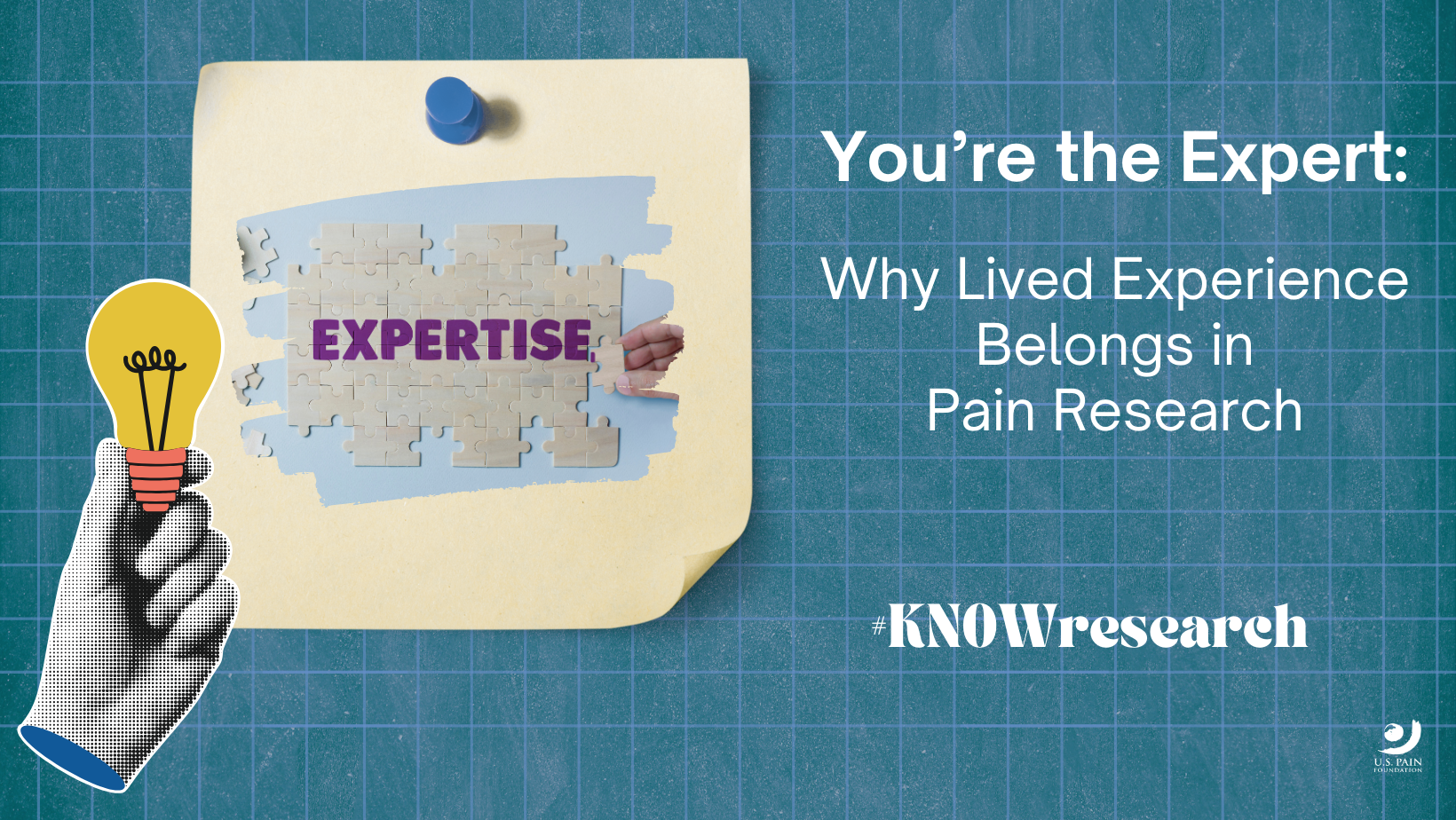
Pain research has traditionally involved the same step-by-step process: Develop a research question. Design a study. Write a grant. Conduct research. Analyze data. Publish findings.
And the same core team generally carries out those steps: A principal investigator or lead researcher. A project manager. At times, a pharmacist. A research assistant. A statistician. Every role, directly research-focused.
What is missing from that list? People with lived experience (PWLE) of pain, the “end users” most impacted by the research’s results, explains Christin Veasley—co-founder and director of the Chronic Pain Research Alliance, a collaborative advocacy initiative focused on increasing federal investment in pain research and promoting meaningful inclusion of PWLE in pain research—during a discussion with U.S. Pain Foundation as part of the #KNOWresearch initiative this KNOWvember.
“Patients and people with lived experience have come forward and challenged this model,” Veasley shares. “The phrase ‘Nothing about us without us’ really stemmed from the disability movement. But over time, it’s been used more broadly to give voice to the idea that those of us who are impacted by medical research have a right to influence what’s researched and how it’s done.”
The crux of this argument is simple, she explains. While the research system historically has assumed that PWLE voices in research would be inherently biased, pain scientists are now recognizing that relevant expertise in research includes not only pharmacy professionals and statistics connoisseurs but those who are experts in what it’s actually like to experience intractable pain.
“We, as people who have lived with chronic pain for a number of years, have valuable experience, and it’s just as valuable as the scientific training that a researcher brings to the table,” Veasley says. “They’re both complementary if they’re both valued and respected.”
A New Model of Pain Research
In the past—and still in some cases today—the involvement of PWLE in research was strictly limited to serving as test subjects. In some instances, individuals with pain may have been briefly consulted for an opinion on an already-crafted research design, a gesture Veasley describes as “tokenistic.”
The revised approach of pain research, which is still finding its footing, expands the team to include voices that are not directly research-focused but are still just as relevant: Health care systems, doctors, and clinicians who eventually might be putting the treatments into clinical practice. Health care insurers, who will be making decisions regarding whether to cover the treatments. And, notably, PWLE—individuals with pain and their care partners who hope the treatment will bring relief and improved quality of life.
In that vein, the National Institute of Health (NIH) ENGAGE Working Group, which Veasley is co-chairing, has spent several years developing the first agency-wide framework for integrating PWLE and the public into every NIH-funded clinical research project.
At its foundation: The idea that community members such as PWLE are equal team members alongside organizations, funders, and researchers in the entire research life cycle, from identifying health needs all the way through sharing research findings.
“The vision was a future where engagement becomes a standard practice,” Veasley shares. “Instead of a small percentage of research studies that are actually incorporating engagement, every study includes engagement.”
The Benefits of Meaningfully Integrating PWLE in Research
The challenges facing today’s pain research landscape are steep. Pain therapeutics have just a 0.7% probability of progressing from Phase 1 to FDA approval, compared to a 6.5% success rate for new drug development for all diseases. And even after a research project is complete—a process that in itself can take many years—it takes an average of 17 years for a new treatment to be regularly used in clinical findings after research findings have been published, Veasley explains.
Bringing PWLE into the process as research partners can help. Doing so, Veasley shares, has proven to:
- Increase study enrollment and retention, including participation of diverse populations
- Reduce time to complete a study
- Decrease the cost of a research project, because the study is optimized from the beginning
- Increase the dissemination of study findings
- Strengthen trust between PWLE and researchers
Equipping the Team
The benefits of PWLE research partnership are clear, Veasley asserts, but the execution can get tricky.
Standard research training for scientists rarely educates them on how to inclusively partner with PWLE. And individuals with pain, while experts in their experience, rarely enter a study understanding the ins and outs of research.
Advocates are creating various resources to help familiarize PWLE with the research process and prepare them to serve as research partners, including the “Research Fundamentals” training from the Patient-Centered Outcomes Research Institute (PCORI). Veasley and other advocates are also working on a first-of-its-kind platform that will connect PWLE wanting to serve as research partners with pain scientists and community organizations. Individuals interested in hearing more about how they can get involved can fill out this brief KNOWvember survey to stay in the loop.
And one effort to better equip pain researchers for effective patient engagement is the National K12 Clinical Pain Career Development Award, which provides early-stage researchers—often just transitioning from clinical practice into pain research—research funding, protected time, specialized training, and mentoring from leading scientists. What makes the program unique is its centering of PWLE, who serve as mentors to pain scientists, co-design and teach the program’s patient-engagement curriculum for researchers, screen research applications, provide feedback on participants’ research projects, and co-present completed research at national science meetings.
K12 scholar Jessica Ma, MD—assistant professor in geriatrics and palliative care at Duke University School of Medicine and a staff physician in the Durham VA Health System—shared during the KNOWvember presentation that early and continuous PWLE input has helped shape, and sometimes change, the direction of her research on pain management decision-making in advanced chronic kidney disease.
“Typically, a lot of project development has been one-sided from the researcher’s point of view,” Ma shares. “What we found during this process is that when patients are part of the research process, the research direction can really change. Involving patients with my research so far has really helped me ground my research on what is most important to patients.”
Maintaining Momentum
A more patient-centric research model is only useful when that research can actually take place—and that means securing funding. And a continued chorus of voices is vital to keep the importance of pain research front and center for Congress, explained Janelle Letzen, PhD, a clinical psychologist whose work bridges scientific research and lived experience, during the KNOWvember discussion. Formerly a health science policy analyst in the now-defunct NIH Office of Pain Policy and Planning, Letzen now works as a program manager for the United States Association for the Study of Pain (USASP).
“Advocating in this area is still important for getting the word out to congresspeople that pain research funding is important,” Letzen explains.
She and Veasley shared several resources that help prepare PWLE for advocacy, including a jointly created collection of materials, talking points, and tips, as well as U.S. Pain Foundation’s advocacy program.
“We still are not receiving the level of pain research funding that we need, and so we really can’t afford to go backward,” Veasley says. “We need to go forward.”
Our 2025 KNOWvember campaign is made possible through the generous support of our sponsors, Vertex Pharmaceuticals and Lilly.
The U.S. Pain Foundation independently developed the content without review from its sponsors. This information is for educational purposes only and may not be used as a substitute for advice from a health care professional.
.
Subscribe to our newsletter

U.S. Pain Foundation is a 501 (c)(3) nonprofit organization dedicated to serving those who live with conditions that cause chronic pain, as well as their caregivers and care providers. Learn more.
Our Sponsors
U.S. Pain Foundation relies on the generosity of donations and grants. We are especially thankful to our Corporate Council for sustaining our programs and services year-round. Learn more.
Contact Us
U.S. Pain Foundation, Inc.
15 North Main Street, Unit 100
West Hartford, CT 06107
Telephone: 800.910.2462
Email:
contact@uspainfoundation.org
Tax ID number: 26-2703521
All Content Copyright 2021 | All rights reserved. U.S. Pain Foundation is a qualified 501(c)(3) tax-exempt organization. Disclaimer